Showing posts with label Bomber Aircraft. Show all posts

Friday, February 3, 2012

T-60S Russia Stealth Bomber Program

T-60S Russia Stealth Bomber Program
Described as smaller compared to the U.S. Air Force B-2 Spirit stealth bomber, the Russian T-60S stealth bomber is being developed by Russian aircraft manufacturer Sukhoi, maker of the famed SU-27 Flanker fighter. The T-60S program reportedly uses a variable "swing" geometry wing and includes extensive stealth design features.

The move toward a stealth bomber is seen as an indication that President Vladimir Putin intends to upgrade every the tactical and strategic weapons used by Russia. The new stealth aircraft will enable the Russian air force to fight a complicated conventional war beyond the borders of Federation and compete directly With the U.S. Air Force.

Sunday, December 25, 2011

B-70 Valkyrie US Bomber Aircraft Program

B-70 Valkyrie US Bomber Aircraft Program
The B-70 was a high-flying Mach 3 bomber, intended to replace the B-52. It was a canarded delta wing aircraft, designed to 'ride' on the shock wave contained between the lower fuselage and its movable, downturned wingtips. Because of kinetic heating at high speed, the B-70 was built from titanium and steel honeycomb parts. The advent of surface-to-aircraft missiles made the high-flying bomber obsolete. Two were built, as two-seat research aircraft.

With research and development studies beginning in 1955, the XB-70 was a large, long-range strategic bomber was planned to be the replacement for the B-52. As in the B-58 program, the Air Force wanted new technology advances. To this end, the Air Force gave the prime contractor total weapon system responsibility. Competition between Boeing and North American for the contract occurred during the design phase. In 1958, the North American design was chosen and a development contract awarded. The Air Force requirement was for a Mach 3, high-altitude, long-range bomber capable of carrying nuclear and conventional weapons. Although there was a technology breakthrough in 1957 that made Mach 3 possible, the XB-70 never went into production. The continuing emergence of new SAMs was the key factor in the demise of the XB-70, just as it affected the B-47 and B-58.

The XB-70 had a length of 196 feet, a height at the tail of 31 feet, and an estimated maximum gross weight of 521,000 pounds. It had a crew of four: pilot, copilot, bombardier, and defensive systems operator. The delta wing had a span of 105 feet with six turbojet engines side by side in a large pod underneath the fuselage. The wing was swept at about 65½ °, and the wing tips were folded down hydraulically 25o to 65o to improve stability at the aircraft's supersonic speeds of up to Mach 3. At this speed the Valkyrie was designed to ride its own shock wave. A large canard foreplane near the front of the fuselage with a span of 28 feet, 10 inches was used for stability. In addition to its sharply swept delta wings, the XB-70s had two large vertical tails. The aircraft was fabricated using titanium and brazed stainless steel "honeycomb" materials to withstand the heating during the sustained high Mach number portions of the flights. The propulsion system consisted of six General Electric turbojet engines (J93-GE 3) with two large rectangular inlet ducts providing two-dimensional airflow.

The entire mission (including return) was to be flown at Mach 3, but even then the aircraft was vulnerable to SAMs of the 1960's vintage. A high altitude, Mach 3 penetrator cannot maneuver well; its straight and level trajectory would have been an easy course to plot and intercept. Further, the technology that made Mach 3 possible yielded an airframe with a large RCS that added to the effectiveness of SAMs against the XB-70. The airframe was not adaptable to low level penetration to avoid SAMs because the delta wings were very thin and did not lend themselves to the structural modifications necessary for sustained, low level flight.

Source : www.fighter-planes.com

Thursday, December 8, 2011

B-1A Lancer Long Range Bomber

B-1A Lancer Long Range BomberB-1A Lancer Long Range Bomber
The first B-1A rolled out on October 26, 1974 and created its maiden flight on December 23 1974. In 1974, AIL was awarded the development contract for the B-1 ECM system; the foremost comprehensive ECM program ever initiated. the development schedule was in more than4 years and was for a 77 Line Replaceable Unit (LRU) band 4 through 7 system. AIL Subcontractors included Litton, Sedco, Northrop, and Tasker. The third prototype, designed as an avionics testbed, carried the initial AIL AN/ALQ-161.

The B-1A design includes four jet engines with afterburner, with two jet engines located below each wing root. The fuselage and wing are blended together, and the variable geometry permits a 15 wing sweep in the forward position and 67.5 when totally swept. The B-1A employs a sensor-controlled automatic system, using movable foreplane vanes to combat low level turbulence. The three bomb bays are capable of carrying eight SRAMs or 25,000 pounds of nuclear or standard bombs each. in addition, there are four external exhausting points each capable of carrying two SRAMs or 10,000 pounds of bombs.

The B-1A has a crew of four: pilot, copilot, offensive systems operator, and defensive systems operator. Originally, the crew was in an escape module, however ejection seats were substituted to save cost and weight. The B-1A has a length of simply over 150 feet, a wing span of 136 feet, 8.5 inches in a fully spread configuration and 78 feet, 2 inches in a swept mode, with a height of 33 1/4 feet, 7 inches. the maximum gross take off weight is 395,000 pounds. The engines have a self-start capability and, therefore, don't need cartridge begin.

Thursday, December 1, 2011

B-47 Stratojet subsonic Bomber

B-47 Stratojet Bubsonic BomberB-47 Stratojet Bubsonic Bomber
B-47 Stratojet research and development began in 1945 with the first prototype flight in December 1947. The Air Force wanted a great height, medium-range, subsonic bomber. At that time, four contractors were developing bombers. Two designs were conventional bombers in the mold of the B-29, while the more radical designs Northrop and Boeing flying wing jet sweep wing. In this era before the SAM, fighter jets were considered the main threat to the terrorists. The Second World War had shown that stripped B-29 with a speed almost of combat and a higher altitude ceiling could only be successfully intercepted from the rear.

The B-47 was the first pure jet strategic bomber with its many unique features include six jet engines, a twin-engine, tower-mounted pod under each wing near the fuselage, and a sheath of a single outboard motor more. The wings were attached high on the fuselage and swept 35. The revolutionary design incorporates a type of bicycle, train, retractable main landing, with only two wheels, stands on the fore and aft fuselage. Outrigger wheel lateral stability and retracted on the deck of two-engine pod. The B-47 was 107 feet long, 28 feet high at the tail, and had a wingspan of 116 feet. The crew consisted of pilot, copilot, and bombardier. With a maximum gross weight of about 204,000 pounds, which used to attend the launch of the rocket. A tail chute is used to slow the aircraft during landing.

Wednesday, November 30, 2011

Tu-22 Blinder Soviet Supersonic Bomber

Tu-22 Blinder Soviet Supersonic BomberTu-22 Blinder Soviet Supersonic Bomber
The Tu-22 "Blinder" was the first Soviet supersonic bomber design intended to replace the Tu-16. The Tu-22 original design aimed at creating a contemporary terrorist could avoid combat interceptors using its high speed and altitude. The mid-range Tu-22 were Anglo-American strike bomber bases and other key objectives of NATO and the U.S. Navy carriers in Europe and Asia.

The Tu-22 design feautres a long and thin, tube-like fuselage with a pointed nose pointing and swept wings. The plane was nicknamed "Shilo" (punch) for his crew for their metallic form, he said. The two Dobrynin VD-7M engines are in pods above the main body, one on each side of the plane's tail. From 1965 these were replaced by improved motor Kolesov RD-7M2. The design improved the flow of air into the engine, minimizing the possibility of medical waste removed from the earth.

Disadvantage of the design problem was the maintenance of engines in this position, the necessary strengthening of the tail section and the front had to be Mas because the center of gravity was in the rear of the aircraft. The main landing gear retracts into separate shelves extend beyond the wing.

Saturday, October 1, 2011

Avro Vulcan British Subsonic Bomber

Avro Vulcan British Subsonic BomberAvro Vulcan British Subsonic Bomber
The Avro Vulcan is a delta wing subsonic bomber that was operated by the Royal Air Force from 1953 to 1984. The Vulcan was part of the RAF bomber force of V, fulfilling the role of nuclear deterrence against the Soviet Union during the Cold War.

It was also used in a conventional bombing role during the Falklands conflict with Argentina. An example, XH558 has recently been restored for use in display flights and commemoration of the role Jets in the Falklands conflict.

Via : www.flightglobal.com

Sunday, August 14, 2011

AMX Brazil / Italy Fighter-Bomber Aircraft

AMX Brazil / Italy Fighter-Bomber AircraftAMX Brazil / Italy Fighter-Bomber Aircraft


The AMX Brazil / Italy Fighter-Bomber Aircraftt, designed to fly at low altitude in high subsonic missions day or night and in poor visibility. It is capable of operating from runways damaged or unprepared. It has a limited number of air-air and integrated ECM capabilities for self defense.


AMX-T two-seat variant of the AMX and used as advanced trainer. The AMX-T retains the operational capability of the single-seat version. The Venezuelan Air Force (FAV) is planning to replace its aging fleet of T-2A Buckeyes with AMX-T. The plane of the Brazilian Air Force (FAB) are called A-1 (car) and TA-1 (two seats). Also the Brazilian AMX aircraft are equipped with two cannons DEFA 544 30mm, while the Italian variant is equipped with a multi-barrel M61A1 20 mm cannon.


Advanced Trainer Attack AMX (AMX-ATA) is a new two-seat AMX, multi-mission attack fighter for combat roles and advanced training. The AMX-ATA adds new sensors, a display of infrared vision, helmet-mounted, a new multimode radar for anti-air capability and anti-ship, and new weapons systems including anti-ship missiles and medium-range missiles.

Saturday, August 13, 2011

B 52 Long-Range Bombers Plane

B 52 Long-Range Bombers PlaneB 52 Long-Range Bombers Plane


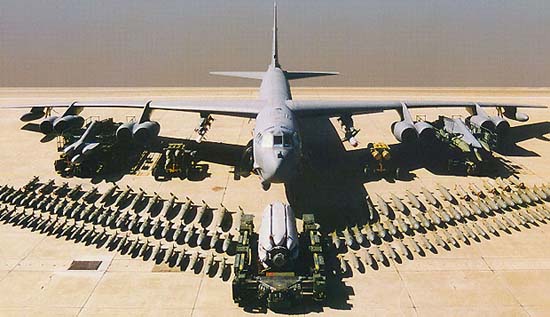
The B 52 is an Long-Range Bombers Plane, with swept wing, a fuselage incorporating bomb bays, and eight engines in pairs of . Later the B-52 was stand-off missiles, 'Hound Dog', on pylons the wing. The 'Big Belly' modification enabled it huge bombs. The B-52 saw combat dropping bombs in Vietnam and lately Gulf. Increasingly vulnerable combat , the B-52 still offers bomb-carrying capacity; plans it were found to be too . It entered service in 1955 2020! The B-52 played with NASA as launch aircraft, carrying into air the X-15 and others. The B-52 was for recce tasks RB-52.


For years B-52 Stratofortresses manned strategic bomber force for the . The B-52 is capable of dropping or launching array of weapons U.S. inventory. This includes gravity and cluster bombs and also precision guided missiles too. Updated with technology, the B-52 continue into the century as of our national defences. Current engineering analysis show the B-52's beyond the year 2045.
The B-52A flew in 1954, B model entered service in 1955. of 744 B-52s were with the last, a B-52H, delivered in October 1962. the H model Air Force inventory are assigned to Air Combat Command.


The first of 102 B-52H's was delivered to Strategic Air Command in 1961. The H model carry up air launched cruise missiles. , it carry cruise missile was launched from B-52G models Desert Storm.


The B-52's electronic countermeasures suite is capable of protecting itself against a full of air defence threat systems by combination of electronic detection, jamming and infrared countermeasures. The B-52 detect and counter missiles the aircraft from the rear. These systems are undergoing continuous improvement to enable them to counter threat systems.

Tuesday, August 9, 2011

Tupolev TU-160 Rusian Supersonic Bomber

Tupolev TU-160 Rusian Supersonic Bomber

The heaviest bomber aircraft ever to be creat, the Tupolev TU-160 (NATO codename Blackjack) could be a supersonic, variable geometry significant bomber designed by the Tupolev design Bureau.


Due to the antiflash white end and wonderful maneuverability the TU-160 was nicknamed by its pilots the White Swan.There are currently 14 White Swans in service with the Russian Air Force.


In 1967 the Soviet Union launched a contest for a replacement supersonic strategic bomber.Both the Tupolev style Bureau and Myasishchev design Bureau responded to the challenge.Myasishchev proposed a variable geometry configuration and in 1973 Tupolev was assigned with the event of the new aircraft because it was considered that it had additional possibilities of finishing the project.Tupolev was to improve the Myasishchev M-18 style using all the data gained with the TU-144 Concordski, the world’s 1st supersonic civilian transport aircraft and also the Tu-22 Blinder supersonic bomber.

Thursday, August 4, 2011

F-111 Aardvark US Strategic Bomber Jet

F-111 Aardvark Strategic Bomber JetF-111 Aardvark Strategic Bomber Jet
The swing-wing F-111 was designed as a multi-role aircraft, however ended as an attack/strike aircraft. it had been the results of an unwise and sad conceive to fulfill completely different USAF and Navy needs with one aircraft. The F-111B shipboard fighter, developed in cooperation with Grumman, was an entire failure. The F-111 strike fighter itself had a tough begin, however accumulated a decent service and combat record in later years. Production was 563 aircraft. One F-111A was changed to the RF-111A/D configuration with cameras and SLAR.

The FB-111 may be a strategic bomber development of the F-111. The FB-111 is longer and might carry a lot of fuel, however does not have real intercontinental range; this is often compensated by its missile armament.

The EF-111A may be a changed F-111A. The F-111A was well-suited for modification to the role of an airborne electronic warfare platform as a result of its structural strength, maneuverability and performance -- together with the flexibility to penetrate enemy airspace and escape at supersonic speed. Exterior modifications embrace a slim canoe-shaped radome, regarding sixteen feet (4.85 meters) long, mounted beneath the fuselage, that house antennas for the high-powered jamming transmitters. Also, a fin-tip pod is mounted on the strengthened vertical stabilizer to deal with receiving antennas and ancillary equipment, together with a processor to detect hostile radar emissions. the entire equipment weight is regarding three.5 tons (3,150 kilograms).

Tuesday, July 19, 2011

B-1B Lancer Long-Range Strategic Bomber

B-1B Lancer Long-Range Strategic BomberB-1B Lancer Long-Range Strategic BomberB-1B Lancer Long-Range Strategic Bomber
The B-1B Lancer is a very impressive long-range intercontinental strategic bomber, developed by U.S. company Boeing for U.S. Air Force. The B-1B is in service since 1986. U.S. Air Force has 67 of these bombers with two of the tests. The crew consists of a pilot who is also commander of the aircraft, a passenger and two weapon system officers. The B-1B Lancer bombers are stationed at Dyess Air Force Base and Ellsworth Air Force Base.

The project for the development of the B-1A to replace the B-52 Stratofortress began in 1970. Four prototypes have been made which could reach a supersonic speed of Mach 2.2. The project was halted in 1977, but test flights continued until 1981.

In 1981 he began again with the development of B-1 of the project. The B-1, who was appointed today as the B-1B has big changes in the burden of a larger weapon than 74,000 pounds, an improved radar and a radar cross-section than an order of magnitude. The air intake ducts have also been modified, but left the maximum speed to about Mach 1.2.
The first B-1B flew in October 1984 and was delivered to the U.S. Air Force Dyess Air Force Base in June 1985. The last was delivered on May 2, 1988. On October 1, 1986, the first B-1B Lancer became operational.

Saturday, June 18, 2011

Tu-22M Backfire Supersonic Bomber Aircraft

Tu-22M Backfire Supersonic Bomber AircraftTu-22M Backfire Supersonic Bomber Aircraft
The Tu-22M Backlash is a all-embracing aircraft developed by the Tupolev architecture agency for accepted attack, anti-ship, assay and nuclear bang missions. The Tu-22 can be able with bombs air-to-surface missiles and was developed for attacks in Europe, Asia and intercontinental mission adjoin the United States. The Tu-22M was developed from the Tu-22 bomber.

This supersonic Soviet bomber was appointed in 1971 in the Backlash and able of aeriform refueling from a tanker. It became one of the best important intelligence debates of the algid war if it was a bomber, periphal advance or intercontinental attack. The key capricious was the best ambit of the aircraft.

Tupolev claimed a ambit of activity for the aboriginal backfires model. The United States Defense Intelligence Agency initially estimated that the backlash would accept a unrefueled action ambit of some 5000Km. But according to the CIA, the backlash would accept a ambit amid the 3360 and 3960 km. The American intelligence association estimated that the Tu-22M wouldn't be a blackmail for the US, but after the US Air Fore estimated that it could be acclimated for a one way intercontinental advance on the United States.

B-36D Peacemaker American's Bomber Aircraft

B-36D Peacemaker American's Bomber AircraftB-36D Peacemaker American's Bomber AircraftB-36D Peacemaker American's Bomber Aircraft

It was the world's aboriginal intercontinental bomber, anniversary costing over $3,700,000 to body starting in 1947. The B-36 appeaser had a aggregation of 15, agitated 86,000 pounds of bombs (conventional or nuclear), had a ambit of 10,000 afar and a wingspan of 230 ft. For its defense, it agitated 24 20mm cannons and a top acceleration of 435 mph.It charcoal the USAF better anytime aircraft and over 300 were fabricated catastrophe in 1958. The B-36 was apathetic and could not refuel in midair, but could fly missions to targets 3,400 mi (5,500 km) abroad and break aloft as continued as 40 hours with its six 28 agent engines aerial at 40,000 ft.

The architecture was already anachronistic in 1947 back jets were common, yet, no adviser had its range. The architecture absolutely began in 1941 and again due to the war, delayed. Even today, alone the 747 and Galaxy C-5 can backpack added than the Peacemaker. The B-36D additionally had four jet engines beneath anniversary addition which advance accustomed for a abundant faster ascent and lift. The agent engines created 3800 hp each! Back all the engines were on, the engines created a absolute of 40,000 hp!!

By 1954, the aircraft was actuality beatific to the scrapyard. But it was not until 1958, that aftermost 22 bombers remained. By 1961, bristles were left. Most of the aircraft were based at Biggs AFB, Texas.

Wednesday, June 8, 2011

Russia - Bomber Plan Tupolev Tu-95

Russia - Bomber Plan Tupolev Tu-95Russia - Bomber Plan Tupolev Tu-95 Picture

Russia's Tupolev Tu-95/142 Bear is after agnosticism the best outstanding descendent of the Boeing B-29, and if assembly activity is any admeasurement of success, it has outperformed its counterpart, the Boeing B-52, decisively, actual in abounding amount assembly able-bodied into the 1990s. While the Bear is generally admired to be antiquated, it charcoal a awful able cruise missile carrier, ISR and targeting platform, encompassing a abundant added ambit of roles than the added specialised B-52 series.

Given the anticipation of bounded operators such as China accepting variants of the Bear, the aircraft should be of ample absorption to assemblage of bounded capability. To bigger appraise the cardinal appulse of the Tu-95/142 Bear in the bounded ambiance APA will analyze this aircraft in some detail.

Wednesday, May 4, 2011

Stealth B-2 Spirit Multi-Role Bomber

Stealth B-2 Spirit Multi-Role BomberStealth B-2 Spirit Multi-Role BomberStealth B-2 Spirit Multi-Role Bomber
The Stealth B-2 Spirit Multi-Role bomber is a versatile capable of delivering conventional and nuclear munitions. Along with the B-52 and B-1B, B-2 provides the flexibility and effectiveness inherent in manned bombers penetration. Its low-observable or "stealth" characteristics give it a unique ability to penetrate sophisticated defenses of an enemy and endanger their most cherished goals, and strongly defended. His ability to penetrate air defenses and threaten effective retaliation was expected to give an effective deterrent and combat force well into the 21st century.

The mixture of low-observable technologies for high aerodynamic efficiency and large payload gave the B-2 bombers benefits most important ones. Its low-observability provides freedom of action at high altitude, increasing its scope and a better view to the aircraft's sensors.

Wednesday, April 27, 2011

F-117 NIGHTHAWK STEALTH AIRCRAFT

F-117 NIGHTHAWK STEALTH AIRCRAFTF-117 NIGHTHAWK STEALTH AIRCRAFT PICTURE

The different architecture of the single-seat F-117A provides aberrant action capabilities. About the admeasurement of an F-15 Eagle, the twin-engine aircraft is powered by two General Electric F404 turbofan engines and has quadruple bombastic fly-by-wire flight controls. Air refuelable, it supports common commitments and adds to the bridle backbone of U.S. aggressive forces.

The F-117A can apply a array of weapons and is able with adult aeronautics and advance systems chip into a agenda avionics apartment that increases mission capability and reduces pilot workload. Detailed planning for missions into awful dedicated ambition areas is able by an automatic mission planning arrangement developed, specifically, to booty advantage of the different capabilities of the F-117A.